 >
>

China Perspective Issues
Book Reviews
XIE, Zhuoxiao. 2024. Chinese Daigou: An Ethnography of Brokerage Practices and Mobility Politics in Globalized China. Singapore: Palgrave Macmillan.
Meina Jia Sandal is a postdoctoral researcher at the Department of Cross-Cultural and Regional Studies, University of Copenhagen, Denmark (mjs@hum.ku.dk).
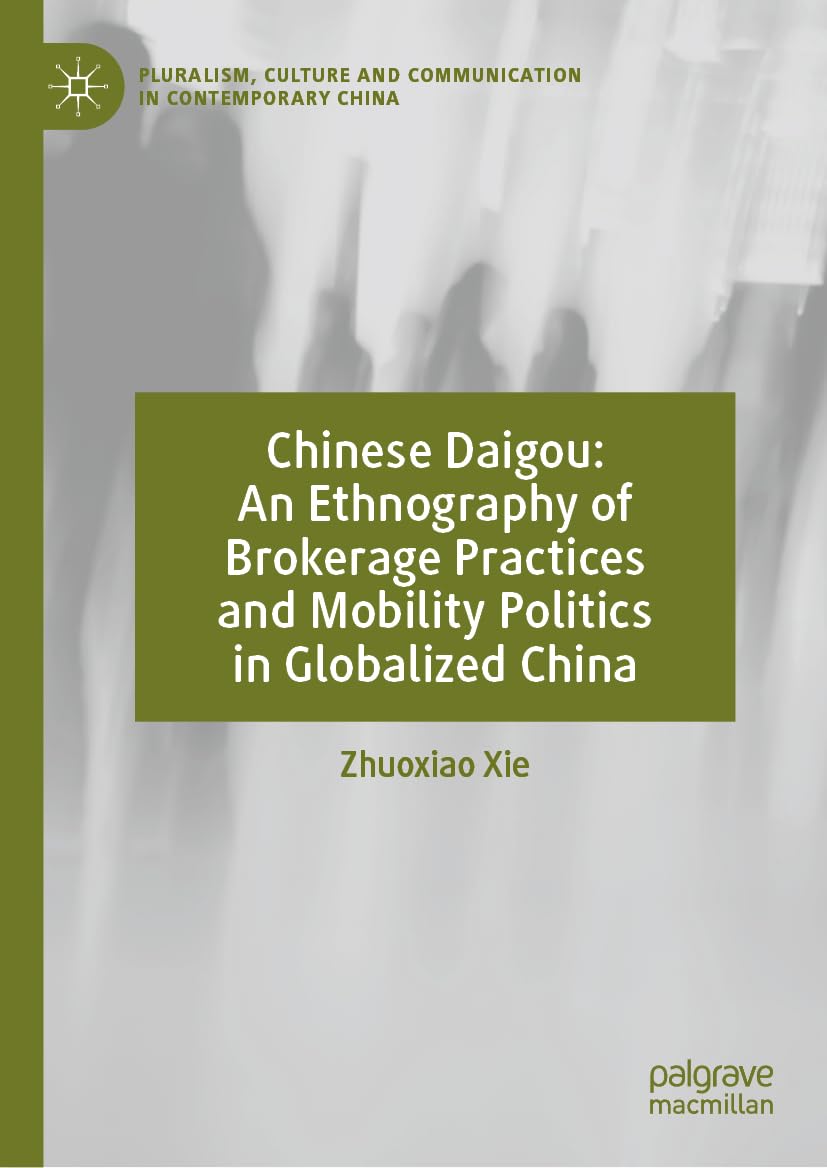 Daigou 代購, literally meaning “buying on behalf of” refers to the practice whereby individuals living outside of Mainland China purchase goods abroad and resell them to customers in China. Over the past two decades, the phenomenon has expanded rapidly alongside growing concerns among Chinese consumers over product safety and authenticity, as well as the development of global consumer markets and digital communication platforms. Zhuoxiao Xie’s book Chinese Daigou: An Ethnography of Brokerage Practices and Mobility Politics in Globalized China offers a detailed ethnographic account of this increasingly visible form of cross-border commerce. Drawing on the concepts of mobility politics and brokerage, the book argues that daigou operates as a form of intermediary practice embedded in mobile communication networks, where the movements of people, goods, and digital technologies reshape patterns of mobility and social inequality in contemporary China (p. 21).
The book is organised into four parts and nine chapters, including the Introduction and Conclusion. Part One situates the study within the broader context of mobility politics in globalised China and outlines the research methodology and theoretical framework. Xie develops brokerage as the central analytical lens for understanding the mediation of cross-border movements of people and commodities. By conceptualising brokerage from a communicative perspective, the author highlights how actors positioned between different social, technological, and spatial domains mediate flows of goods and information. In this framework, brokerage relations illuminate how the mobilities of people and objects are negotiated through social gaps and power asymmetries. This conceptual foundation allows the study to examine how daigou practitioners navigate uneven mobilities produced by global markets, digital platforms, and regulatory structures.
Part Two focuses on platform-based trading practices and the role of digital infrastructures in shaping daigou activities. Xie shows how practitioners rely on social media platforms, particularly WeChat, to organise their businesses as forms of mobile micro-entrepreneurship. Through online profiles, images, and live documentation of purchasing activities, daigou practitioners make their spatial mobility visible and construct credibility among customers. The profiling practices, management of online self-presentation, and instant communication also function as “expressions of interactive service labour” that promote commodities and facilitate customer consultation (p. 116). This part also highlights the gendered character of platform-based service labour. Interactions between sellers and customers frequently rely on gendered expectations regarding communication styles, emotional labour, and bodily presentation, reinforcing a common view among daigou practitioners that “full-time daigou are mainly married women who do not work” (p. 101).
Part Three turns to purchasing practices in Hong Kong, where daigou shoppers act as catalytic brokers linking local retailers and Mainland Chinese customers. Through detailed accounts of shopping routines, including lining up for popular products and coordinating with suppliers, this part illustrates how practitioners construct professional identities through mobility and place-based knowledge (p. 179). Purchasing is not simply a technical step in the trading process but a socially meaningful practice in which practitioners demonstrate diligence, competence, and familiarity with local consumer culture.
Part Four examines logistics practices in daigou, particularly renrou daigou 人肉代購, a form of purchasing-on-behalf in which goods are physically carried by people across places. Unlike daigou more generally, which refers to cross-border purchasing and resale, renrou daigou emphasises bodily transportation as part of the trading process. Xie conceptualises these practices as forms of “mediated corporeal mobility,” in which the movements of people, goods, and digital communication are intertwined through mobile technologies (p. 240). This part also highlights how these arrangements produce differentiated patterns of labour and mobility, particularly in family-run shops where logistics work often reproduces gendered divisions of labour (p. 233).
One of the strengths of this ethnographic study lies in its multilayered analytical approach. At the empirical level, the book provides detailed descriptions of daigou practices, illustrating who participates in these activities, where they take place, and how transactions unfold across different spaces and infrastructures. Building on these materials, the author develops a second level of analysis by conceptualising daigou practitioners as brokers who mediate relationships between consumers, markets, digital platforms, and regulatory environments. This perspective highlights the relational nature of daigou activities, and the strategic positions practitioners occupy within cross-border exchange networks. Finally, at a theoretical level, the study contributes to the development of brokerage theory by incorporating insights from gender analysis and technological transformation. By examining how mobile communication technologies and digital platforms shape brokerage practices, the book expands existing discussions of brokerage beyond traditional economic contexts.
At the same time, the study leaves open an important question concerning the broader structural conditions that give rise to and sustain daigou practices. While the book convincingly explains how daigou operates as a brokerage process, it pays less attention to why such intermediary networks continue to thrive. In an era of expanding globalisation and digital commerce, when consumers can increasingly access overseas products through online platforms and international retail channels, the persistence of daigou raises an important puzzle. Why do consumers continue to rely on these intermediaries despite the growing accessibility of global goods? A deeper engagement with the demand-side dynamics of daigou consumption, including issues of trust, authenticity, and consumer perceptions of global markets, might have further strengthened the analysis.
Nevertheless, the book Chinese Daigou provides a valuable ethnographic contribution to the study of cross-border consumption and mobility in contemporary China. By combining detailed fieldwork with a conceptual discussion of brokerage and mobility politics, the book sheds light on the complex social, technological, and gendered dynamics underpinning this form of transnational commerce. It will be of interest to scholars of China studies, economic anthropology, and digital platform economies, as well as readers seeking to understand the transformations of cross-border consumption in the globalised marketplace.