 >
>

China Perspective Issues
SPECIAL FEATURE
What is Driving the US and China to Compete – and Potentially Fight – Over Taiwan: A Neo-offensive Realist Analysis
Brian C. H. Fong is Distinguished Professor and Associate Dean of the College of Social Sciences, National Sun Yat-sen University, Kaohsiung, Taiwan (brian.fong@mail.nsysu.edu.tw).
Where do great powers compete? What makes a place a critical domain of great power competition? What motivates great powers to compete – and potentially fight – over one domain but not others? Interestingly, such critical research questions, which pertain to the trajectory of global politics, have thus far remained under-discussed within international relations scholarship. Applying an emerging theory called “neo-offensive realism,” this article advances the literature by investigating the causal impact of conflicting national interests in driving US–China competition and potential war over Taiwan.
I aim to achieve a three-fold objective in this article: first, to introduce the neo-offensive realism theory, which provides a general theoretical framework for explaining and predicting where great power competition is going to emerge in a particular domain; second, to empirically test and apply neo-offensive realism in the context of Taiwan under the contemporary US–China competition; and third, to draw theoretical and practical lessons from the case study of US–China competition in Taiwan. Overall, this article proposes a theoretical mapping of the different dimensions of US–China competition over Taiwan, while also providing a broader framework for the other contributions gathered in this special feature.
Theoretical framework: Theorising where great powers compete
The status of existing literature
“Great power competition” is an intermediate phenomenon situated between “great power cooperation” and “great power war.” It refers to great powers’ contest for supremacy across different domains; and in such a contest great powers will adopt all measures short of direct armed conflict to out-compete their rivals (Fong 2024a). Great powers can broadly defined as consequential states capable of projecting power influence beyond their own territorial borders, conceptually including “global powers” (whose power projection span across the globe) and “regional powers” (whose power projection stretch over a particular region) (Fong 2025a, 2025b).
Historically, great powers rise and fall, but great power competition is a constant feature of world politics. In retrospect, the Britain–Russia “Great Game” in Central Asia (1830s–90s), US–Britain competition in the Western Hemisphere (1890s), Russia–Japan competition in Northeast Asia (1880s–1900s), US–Japan competition in the Pacific (1920s–30s), and US–Soviet competition in the Third World (1945–91) were all illustrative examples of how great power competition unfolded in different domains during different time periods.[1] Contemporarily, the US “unipolar moment” had once effectively reduced – although not completely eliminated – great power competition in the 1990s and 2000s (Krauthammer 1990, 2002). But as a consequence of the relative decline of the US since the 2008 financial tsunami, great power competition has reemerged in major geopolitical theatres. Currently, China, Russia, and Iran are contesting the US and its allies for strategic influence, from the Indo-Pacific and the Euro-Atlantic to the Middle East and Latin America (Fong 2024a).
It is beyond doubt that great power competition is an international relations phenomenon in which great powers are competing somewhere. Yet, where do great powers compete? While such a research question is critical to our understanding of the nature and characteristics of great power competition, academic research on this topic thus far remains thin and limited.
There are two major limitations to the existing literature. First, there exists no theoretical framework that systematically accounts for where great power competition is going to emerge in a particular domain. Existing literature does generally document how great powers are competing in “strategically important areas.” To name some recent examples: Grygiel and Mitchell (2017) explain how the US global alliance network is geographically centred on those frontier countries such as island chain countries namely Japan, South Korea, Taiwan, Singapore, Thailand, the Philippines, and Australia in Indo-Pacific – that are located in close proximity to China. Sahakyan (2021) examines how Central Asian countries are currently becoming domains of great power competition because of their locations as strategic crossroads of East–West and North–South trade. Kepe et al. (2023) argues that the US, China, and Russia are now competing in those African countries that are in strategic locations (such as Sudan in respect of access to the Red Sea and the Indian Ocean as well as North African countries in respect of access to the Mediterranean Sea) and that hold strategic natural resources (such as the Democratic Republic of the Congo in respect of cobalt production and Nigeria in respect of oil production).
While it is common for scholars – and practitioners in the real-world policy community – to discuss the strategic importance of certain domains to great powers, few attempts have been made thus far to theorise the phenomenon. For example, there is no typology that systematically classifies the different traits and types of “strategic importance” in different domains; there is also little effort to theorise the causal mechanism as to how so-called “strategic importance” has driven great powers to compete over one domain but not others. Such critical issues can only be addressed by developing a theoretical framework that helps better structure the empirical analysis across different cases.
Second, the extant literature is primarily state-centric and thus neglects the theoretical and practical importance of political entities that fall outside the orthodox definition of sovereign states in great power competition (Fong 2025a, 2025b). Traditionally, international relations is a state-centric discipline that adopts sovereign states as its ontological, default unit of analysis (Hay 2013). By conceptualising sovereign states as the building blocks of the international systems, mainstream schools of thought in the discipline – including realism, liberalism, and constructivism – all follow this state-centric approach when building their theories (Paul 1999). For decades, this state-centric approach has been widely justified by scholars as necessary to the construction of simple, elegant theories, helping them to include what are considered important (sovereign states) and to exclude what are assumed to be unimportant (quasi-states) in the process of theory building (see Waltz 1979: 95; Lake 2008). The state-centric approach has shaped the worldview of generations of international relations scholars, with small states being widely studied as domains of great power competition. When studying the Cold War, for example, scholars primarily focused on US–Soviet competition in small states in the Third World (Fong 2025a, 2025b).
Since the 2010s, this “great power–small state” approach has been recycled in the revival of great power competition studies, with US–China–Russia competition in small states continuing to be the predominant research focus (see Efremova 2019; Galal 2019; Kassab 2020; Can 2024). This state-centric approach is clearly far from comprehensive for reading the geopolitical map, because in reality the world includes a large number of quasi-states, many of which are critical domains of great power competition that scholars and researchers cannot – and should not – overlook (Fong 2025a). Indeed, in recent years pioneering scholars have been exploring great power competition in quasi-states such as Gagauzia (Cantir 2015), Greenland,[2] Hong Kong (Fong 2022a), Nagorno Karabakh (Kurt and Tüysüzoğlu 2023), and Taiwan (Huang and Wu 2023). But generally speaking, such quasi-state-oriented studies remain largely marginal in contemporary great power competition studies.
Neo-offensive realism as an emerging theory
This article advances the study of “where great powers compete” by applying neo-offensive realism to the context of US–China competition over Taiwan. Building on John Mearsheimer’s classical offensive realism theory (Mearsheimer 2001), neo-offensive realism offers, perhaps, the first holistic theoretical lens for explaining where great powers compete in both states and quasi-states (Fong 2024b). Overall, neo-offensive realism includes four “conceptual add-ons” to the original offensive realism theory, namely the “integration of system-level and unit-level explanations” (for studying why great powers compete), “reorientation of states and quasi-states” (for studying where great powers compete), “combination of military and economic perspectives” (for studying how great powers compete), and “incorporation of scenario analysis techniques” (for studying where great power competition is headed) (Fong 2024b: 19–33). Evidently, the second add-on of neo-offensive realism is highly relevant to the research question of this study, i.e., what drives the US and China to compete – and potentially fight – over Taiwan?
As a grand theory, neo-offensive realism hypothesises that great powers will compete in a particular state/quasi-state where their prevailing national interests conflict. Such a hypothesis is built upon two major conceptual components, namely “national interests” and “states and quasi-states,” which are derived and adapted from the relevant literature.
First, neo-offensive realism incorporates the concept of national interests, hypothesising national interests as drivers of great powers’ strategic focus and their pursuit of a particular domain (ibid.). In international relations literature, national interests are broadly defined as the perceived priorities that a great power seeks to pursue regarding its external environment (Nye 1999). International relations scholars have generally agreed that states behave according to their national interests, although different schools of thought have quite different understandings of what constitutes national interests (Burchill 2005).
In literature, there are generally two types of theoretical approaches in respect of national interests. The first approach is system-level theories. Structural realists – including both defensive and offensive realists – define national interests as security-oriented. For example, Kenneth Waltz, the founding father of structural realism and a defensive realist, theorises that international anarchy will incentivise all states to accord top priority to security. In other words, security as a national interest is an exogenous product resulting from the structure of the international system (Waltz 1979: 134). John Mearsheimer, the leader of offensive realism, hypothesises that under international anarchy, states will maximise their security by maximising their relative power. In Mearsheimer’s world, “security goals” always trump “non-security goals” such as economic prosperity and ideological promotion in terms of foreign policy prioritisation, especially when such goals come into conflict with each other in times of intense great power competition (Mearsheimer 2001: 31, 46–8). All in all, structural realists see states’ national interests as security-oriented, something that is imposed by – and also continuously shaped by – system-level forces through a top-down process.
The second approach is unit-level theories. Liberals, such as Keohane (1982), Putnam (1988), and Moravcsik (1997), have rejected the structural realists’ top-down theorisation of national interests. They argue that national interests are endogenously constituted at unit level by domestic political systems, through which the interests of individuals and groups are aggregated through a bottom-up process. Such a bottom-up approach also prompts liberals to argue that apart from security, other interests such as economic welfare, ideological promotion, and international institution-building may prevail from case to case. Similar to classical realists and liberals, constructivists see national interests as something endogenously driven by unit-level domestic politics. Yet, constructivists argue that national interests arise from a state’s self-definition and interpretation of its external environment. Weldes (1996), for example, argues that the content of national interests is not self-evident but is continuously constructed by domestic political players at unit level through a process of interpretation and communication; while Finnemore (1996) argues that foreign policy is essentially about defining, but not defending, national interests.
In the development of its hypothesis on “where great powers compete,” neo-offensive realism adapts and incorporates Donald Nuechterlein’s classical typology of national interests. According to Nuechterlein (1976), there are four major types of national interests, namely defence interests (the defence of the country’s homeland against military threats from other countries, including external threats to its system of government), economic interests (the enhancement of the country’s economic well-being), ideological interests (the promotion of values, norms, and beliefs that the country and its people consider universally good), and world-order/overseas interests (the maintenance of an international political-economic system that protects the country’s security, especially in respect of the security of its overseas citizens and enterprises operating outside its territorial borders). By incorporating Nuechterlein’s comprehensive typology, neo-offensive realism builds a theoretical framework that conceptually encompasses the different dimensions of national interests as theorised by both system-level scholars (security-oriented defence interest as defined by structural realists) and unit-level scholars (economic, international institutional, and ideological interests as defined by liberals and constructivists).
Second, neo-offensive realism brings in the concept of quasi-states, hypothesising quasi-states as potential domains of great power competition alongside traditionally defined small states (Fong 2024b: 19–33). Conceptually, a defined territory, a permanent population, an effective government, and the capacity to enter into relations with other states are the four widely accepted conditions of sovereignty (Taylor 1997); and correspondingly quasi-states are political entities that exercise such sovereign powers at “distinct-scale” but not “full-scale” (Paul 1999). These quasi-states often originate from “remnants of former colonial empires” (Ferdinand, Oostindie, and Veenendaal 2020: 43), operating in the contemporary international system as an intermediate category situated between states and non-state actors. This makes such quasi-states fundamentally different from regional and local governments commonly found within established sovereign states (Veenendaal and Oostindie 2018).
Empirically, there are three ideal types of quasi-states in the world today, which exercise quite different “distinct-scale” sovereign powers (Fong 2025a, 2025b). First of all, there are altogether 13 “associated states” such as Bhutan, Marshall Islands, Micronesia, and Palau. They are all “modern protected states” that legally transfer their sovereign powers on defence and foreign policy – usually through an international treaty – to a great power in exchange for benign protection (Watts 2009; Dumieński 2014, 2020). Secondly, there are altogether 13 “contested states” such as Abkhazia, South Ossetia, Kosovo, Nagorno Karabakh, Taiwan, and Transdniestria. They are all political entities that exercise effective government controls over their own populations and territories, while falling to get internationally recognised legal status, especially United Nations’ membership. Finally, there are altogether 72 “territorial autonomies” such as Åland Islands, Bougainville, Catalonia, Faroe Islands, French Polynesia, Greenland, Hong Kong, Jammu and Kashmir, Macao, New Caledonia, Northern Mariana Islands, Guam, Gagauzia, Québec, Scotland, South Tyrol, and Wales. They are all asymmetric, self-governing autonomous regions that operate within a sovereign state (Fong 2022b). Obviously, many of the aforementioned quasi-states are critical domains of US–EU–China–Russia competition today. For example, US–China competition is currently unfolding in Marshall Islands, Micronesia, Palau, Taiwan, Greenland, Hong Kong, Northern Mariana Islands, and Guam, while US–EU–Russia rivalry is escalating in Abkhazia, South Ossetia, Kosovo, Transdniestria, and Gagauzia (Fong 2025a, 2025b). By bringing in the concept of quasi-states – alongside small states – into a theoretical framework, neo-offensive realism helps broaden our imagination of where great powers are competing today.
All in all, by combining the concepts of “national interests” and “quasi-states,” neo-offensive realism advances an integrated theoretical framework that addresses the research question of where great powers compete. The concept of national interests enables us to systematically track what motivates great powers to pay attention to and seek dominance over a particular domain, while the concept of quasi-states allows us to move beyond the state-centrism in orthodox international relations scholarship and explores those under-researched domains of great power competition. By combining the two critical concepts of “national interest” and “quasi-states,” neo-offensive realism hypothesises that great powers will compete over a particular state or quasi-state where their prevailing national interests conflict (with “national interests” being theorised as an independent variable and “locus of a state/quasi-state” being theorised as a dependent variable). In other words, the more intense the conflict of national interests between rival powers within a particular state or quasi-state, the more intense their competition over that state or quasi-state becomes.
Case application: The US and China’s conflicting interests in Taiwan
This article empirically examines the research question of where great powers compete through the case study of Taiwan, using the neo-offensive realism theory (see also the other articles in this special issue). There are strong theoretical reasons for adopting Taiwan as the research site. Firstly, there is a growing consensus within global academic and policy communities that Taiwan is at the centre of US–China rivalry today. Indeed, in recent years there is a burgeoning body of scholarly literature (e.g., Hsieh 2020; Yuan 2023; Lee 2024) and policy reports (e.g., Hass 2022; Emmott 2024)[3] about the importance of Taiwan as a principal domain of US–China competition. Yet, few theoretical attempts have been made thus far to systematically theorise the drivers that motivate both China and the US to compete, and potentially fight, over Taiwan. This article attempts to fill this literature gap. Secondly, Taiwan is one of the most critical cases of quasi-states in the contemporary world. Since the defeat of the Kuomintang (KMT) by the Chinese Communist Party (CCP) in the civil war and the establishment of the People’s Republic of China (PRC) in October 1949, Taiwan has emerged and existed in this world as a contested state bearing the official name of the Republic of China (ROC) for more than seven decades.[4] Although continuously contested by the PRC as a “breakaway province,” Taiwan ROC has struggled through the Cold War and post-Cold War periods. Today, Taiwan is well known around the world as a liberal democracy and an advanced techno-economy, while continuing to pursue its political survival and international legal recognition as a contested state. Therefore, Taiwan serves as a critical case of great power competition over a quasi-state from the Cold War to New Cold War, providing the empirical breadth and depth needed to test the validity of the neo-offensive realist framework.
The overarching scholarly argument of this article is that US–China competition – and potential war – over Taiwan are driven by their conflicting national interests in the island. In the following paragraphs, I shall empirically develop this argument, using a neo-offensive realist lens.
Conflicting defence interests
The US and China have conflicting defence interests in Taiwan. The US sees Taiwan as a critical component to its West Pacific defence system under the so-called island-chain strategy, while China considers it critical to prevent Taiwan from being used by rival powers to threaten its security. Actually, such conflicting defence interests between the US and China are longstanding, dating back to the Cold War period. In recent years, these conflicting defence interests have intensified again as a consequence of the two great powers’ rising threat perception against each other.
US defence interests in Taiwan can be traced back to the early Cold War years. Following the outbreak of the Korean War (1950–53), Washington revamped its grand strategy in Asia by embracing the strategic concepts of island chains. To contain the expansion of Sino-Soviet communism into the Pacific Rim, Washington engineered a defence system that spanned across three island chains. The first island chain extended from Japan to the Philippines, Borneo, and the Malay Peninsula; the second island chain stretched from Japan to Micronesia, Melanesia, and Australia; the third island chain spanned from Alaska (Aleutian Islands) to Hawaii, American Samoa, Fiji, and New Zealand. These three island chains symbolised Washington’s efforts to develop a new US-led defence system in the West Pacific (Umetsu 1996). The KMT regime in Taiwan, which was in the middle of the first island chain, found itself becoming a critical component of the new island-chain strategy (see Lim 2026).
US defence interests in Taiwan motivated it to step up its military, economic, and diplomatic support to the KMT regime in order to prevent the island from being captured by Beijing. Such efforts were first illustrated by the US deployment of the Seventh Fleet to “neutralise” the Taiwan Strait on 27 June 1950 and were later formalised through the signing of the Sino-American Mutual Defence Treaty between Washington and the KMT regime on 2 December 1954. Even after the normalisation of Washington–Beijing diplomatic relations in the 1970s, US defence interests in Taiwan drove it to maintain its defence commitment to the island in a subtle way through the 1979 Taiwan Relations Act (TRA) (Lin and Zhou 2018).[5]
In recent years, China’s rising military power as a potential hegemon in Asia has revived General MacArthur’s warning in the mind of Washington elites. Today, there is a growing consensus within policy circles in Washington (the “Beltway”) that China’s control over Taiwan will shift the overall military balance between the People’s Liberation Army (PLA) and US forces in the Indo-Pacific. In the eyes of Washington planners, controlling Taiwan will enable Beijing to gain a strategic foothold in the first island chain. This will provide Beijing with the leverage to control the sea lines of communication in the West Pacific, empowering it to choke commercial trade and US naval deployments in the region (McKinney and Harris 2021). Worse still, if Washington fails to stop Beijing from controlling Taiwan, especially in the case of a military takeover, the credibility and deterrence of the US-led defence system in the West Pacific is likely to collapse. US allies in Asia – Japan, South Korea, the Philippines, Australia, and New Zealand – will question Washington’s capability and resolve to come to their defence should it fail to defend Taiwan (Maher 2023). The extensive, and rising, US defence interests in Taiwan in this age of great power competition are best illustrated by the “MacArthur-like” statement made by the Pentagon’s Assistant Secretary of Defence for Indo-Pacific Security Affairs, Ely Ratner, at a congressional hearing held on 8 December 2021:
Taiwan is located at a critical node within the first island chain, anchoring a network of U.S. allies and partners – stretching from the Japanese archipelago down to the Philippines and into the South China Sea – that is critical to the region’s security and critical to the defence of vital U.S. interests in the Indo-Pacific.[1]
Recently, the second Trump administration further explicitly described Taiwan’s pivotal location in the first island chain as the most important factor warranting US strategic focus – more important than semiconductor production – because the island “provides direct access to the second island chain and splits Northeast and Southeast Asia into two distinct theaters.”[2]
These US defence interests in Taiwan are in sharp conflict with China’s defence interests. In the eyes of Beijing elites, the modern history of China has repeatedly shown that Taiwan has continuously been used by rival powers as a military bridgehead to threaten the Mainland regime. Historical incidents include the Dutch East India Company’s use of Penghu to force the Ming empire to open trade relations in the early seventeenth century; Koxinga’s use of Taiwan to build a separate regime to resist the Qing empire during the mid-seventeenth century; France’s use of Penghu and Keelung to threaten the Qing empire during the 1884–85 Sino-French War; and US incorporation of Taiwan into its island-chain strategy to contain communism during the Cold War. Chinese ships were blocked by US and KMT forces from passing through the Taiwan Strait for more than three decades following the founding of the PRC – effectively cutting off direct access between northern and southern Chinese ports –, a blockade that only ended in the late 1970s.[3] Therefore, China has a longstanding defence interest in preventing Taiwan from becoming, once again, a rival power’s military bridgehead that can threaten its national security (Wachman 2007: 33–44).
Today, the rival power that is using Taiwan to threaten China’s national security is – in the eyes of Beijing’s leaders – undoubtedly the US. Indeed, the intensification of US–China rivalry in recent years has only served to harden Beijing’s defence interests in preventing “external forces” from militarily controlling Taiwan. For Beijing’s leaders, US attempts to strengthen its military support to Taiwan in recent years are only a revival of its Cold War-style containment strategy against China.[4] This strategic calculus has been illustrated by Beijing officials’ frequent remarks about the US manipulation of the “Taiwan card” on various occasions, such as a speech by Chinese Ambassador to US Xie Feng on 22 April 2024:
[There are] external forces, who are using Taiwan as a card to contain China, attempting to turn Taiwan into a “porcupine”. These forces and the “Taiwan independence” separatists emboldened by them pose the real risks and biggest threats to the status quo and peace and stability across the Strait.[5]
Conflicting economic/defence interests
The US and China have complicated economic/defence interests regarding Taiwan’s chip supply, an issue with implications both economically and militarily. In the contemporary world, semiconductors are extensively used as essential components of almost all kinds of civilian and military electronic devices. Semiconductors not only empower civilian devices such as computers, mobile phones, televisions, video games, automobiles, and medical diagnostic equipment, but also empower satellites, radar systems, fighter jets, and missile systems. Since the 1990s, Taiwan has developed itself into a premier semiconductor manufacturer. The Taiwan Semiconductor Manufacturing Company (TSMC) is the world’s largest chip manufacturer, occupying 53.4% of the world market and producing 92% of the most advanced chips (below 10 nanometres) necessary for artificial intelligence and quantum computing applications.[6] This has made both the US and China (and also many other countries) heavily dependent on Taiwan – effectively meaning TSMC – for the supply of advanced chips (Figure 1). Because of the dual-use nature of semiconductors, such dependence implies that both the US and China have complicated economic/defence interests over Taiwan on this point.
Figure 1. TSMC customers by geography (TSMC net revenue based on the countries where the customers are headquartered)
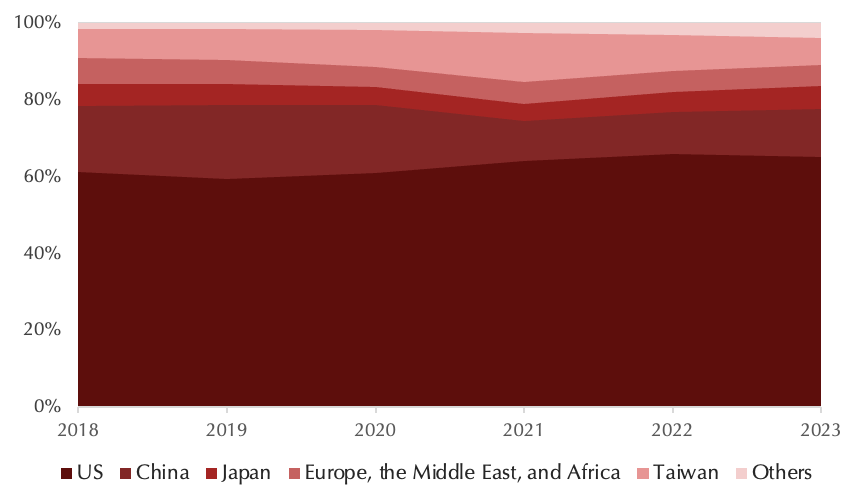 Source: author’s own compilation based on TSMC Annual Reports.
The heavy dependence of the US on Taiwan’s chip supply is obvious in both the economic and military arenas. For instance, major US tech giants, including Amazon, AMD, Google, Apple, and Nvidia, imported 90% of the chips they require for day-to-day business operation and production – including data centre processors, graphics cards, 5G communications systems, and smartphones – from TSMC.[7] Likewise, the US Department of Defense is dependent on TSMC military-grade chips to operate its cutting-edge defence systems, including F-35 fighters and a range of weapons and devices such radar and radio communication that adopt field-programmable gate array (FPGAs) technologies.[8] Further, because technology is a major domain of US–China competition today, and denying Beijing’s access to the most advanced semiconductors is an important strategic objective of Washington, Taiwan inevitably finds itself at the centre of the geoeconomic chessboard. On the one hand, Washington cannot afford to let China control Taiwan’s semiconductor industry and gain an upper hand in the technological competition; on the other hand, Washington is actively urging Taiwan and other allies, especially the Netherlands, Japan, and Korea, to fully align themselves with its semiconductor export controls against Beijing through the “Chips Alliance.”[9] In other words, US economic/defence stakes in Taiwan today could not be much higher owing to semiconductors.
China is also structurally dependent on Taiwan’s chip supply, especially the most advanced chips manufactured by TSMC. As a manufacturing power, China requires a substantial quantity of semiconductors to sustain the development of its domestic consumer electronics industry. Despite tremendous efforts to achieve self-sufficiency in chips, China remains the world’s largest importer of semiconductors. In 2021, China imported more than USD 430 billion worth of semiconductors, the value of which was consistently higher than that of imported crude oil. Of these semiconductor imports, 36% came from Taiwan, including the most advanced ones produced by TSMC.[10] China’s dependence on Taiwan’s chips means that it has a substantial economic interest in laying its hands on the island. This does not mean that China would attack Taiwan solely because of its economic interests in accessing the island’s semiconductors. Rather, a military takeover of Taiwan would almost certainly result in China being denied access to the semiconductor technologies and equipment supplied by the US and its allies, including Japan, South Korea, and the Netherlands, all of which are necessary for operating Taiwan’s wafer facilities. Yet, the bottom line is that China has strong economic incentives to prevent Taiwan from fully aligning with the US geoeconomic agenda of restricting its access to advanced chips.[11]
Conflicting ideological interests
The US and China have conflicting ideological interests over Taiwan. During the Cold War, US support to the KMT regime in Taiwan was partly driven by the island’s critical role in anticommunist propaganda. Moving into the contemporary years, US ideological interests in Taiwan have changed from anticommunism to promoting democracy following the island’s transformation into a liberal democracy since the 1990s. For China, Taiwan has always been a focal point of its official nationalism-building projects since the founding of the PRC in 1949. In China’s official nationalism narratives in recent years, Taiwan has become the last missing jewel in the crown of “Chinese national rejuvenation.”
Ideological interests have always been a critical driver of US policy towards Taiwan. During the Cold War, Washington regarded the KMT regime in Taiwan – the so-called “Free China” – as a “beacon of anti-communism,” providing a meaningful and sharp contrast to “Communist China” on the Mainland as part of its global ideological propaganda against communism (Gold 2023: 188). In a statement of policy by the National Security Council written in 1953, Washington explicitly stated its ideological interests in Taiwan:
The Chinese Government on Taiwan is a considerable asset to the U.S. position in the Far East. The existence of the Chinese Government on Formosa offers an at least symbolic alternative to Communist control of the mainland, and helps to frustrate the Communist objective of gaining international acceptance as the sole representative of the Chinese people.[12]
US ideological interests in Taiwan remain solid in the twenty-first century. But the content of such ideological interests has changed significantly over time. As a consequence of Taiwan’s transition from an autocratic one-party regime into a full democracy since the 1990s, US ideological interests over the island have shifted from anti-communism to promotion of democracy. Transformed from a “beacon of anti-communism” to a “beacon of democracy,” Taiwan has continued to enjoy strong bipartisan ideological support in Washington. For example, over the years, successive US presidents such as George W. Bush and Barack Obama have indicated their commitment to supporting the shared democratic values between Washington and Taipei (Hickey 2013). During the first Donald Trump administration (2017–2021) – despite the President himself having little personal interest in democracy promotion – senior US officials such as Secretary of State Micheal Pompeo continued to highlight US commitment to Taiwan based on their shared democratic values.[13] In particular, under the first Trump administration a new annual dialogue mechanism, called the “U.S.-Taiwan Consultations on Democratic Governance in the Indo-Pacific Region,” was founded in September 2019 as a platform for the US and Taiwan to develop joint regional projects on democracy promotion (Bao 2023). Under the Joe Biden administration (2021–2025), Washington advanced a more explicitly ideologically-based foreign policy narrative – the “Biden Doctrine” – claiming that currently “democracies and autocracies are engaged in a contest to show which system of governance can best deliver for their people and the world.”[14] In this new ideological war, cross-strait relations have been re-framed by bipartisan Washington elites as defence of a vibrant democracy (Taiwan) against the aggression of the largest autocracy in the world (China) (ibid.). While the rhetoric of defending democracy against autocracy has been significantly reduced among senior officials since Trump’s return to the White House, bipartisan support for Taiwan’s democracy against China’s authoritarian coercion remains strong within the Beltway. A clear example is the joint statement issued by Senators John Curtis (Republican) and Jeff Merkley (Democratic) when introducing the bipartisan Taiwan Relations Reinforcement Act, which was subsequently passed by Congress and signed into law by President Trump on 2 December 2025:
The United States must use all the tools at our disposal to strengthen our relationship with Taiwan, one of East Asia’s most vibrant democracies, and together advance our shared vision of a world that is built on democratic governance, human rights, and the rule of law.[15]
For China, its ideological interest in Taiwan is, of course, closely tied to official nationalist narratives surrounding Chinese national unification. From Mao Zedong to Hu Jintao, “unifying Taiwan with the motherland” has been the official objective of all PRC leaders and a critical element in its official nationalism-building. But for many decades, Beijing leaders did not demonstrate much sense of urgency to realise this nationalist claim, as famously shown by Mao Zedong’s remarks in 1973: “I say that we can do without Taiwan for the time being, and let it come after 100 years.”[16] Deng Xiaoping later set re-unification with Taiwan as one of the top three political priorities in the 1980s and reframed the question of Taiwan (and Hong Kong) more closely with “national humiliation discourse” (Karmazin 2017). But in practice, Beijing under Deng, Jiang, and Hu remained largely patient in pushing forward “peaceful unification” and did not indicate any sense of urgency (Schubert 2024).
Yet, there have been some nuanced changes in the official nationalism narratives since Xi Jinping took office in 2012. Positioning himself as a transformative leader, Xi Jinping has made the “great rejuvenation of the Chinese Nation” his political legacy and had brought Chinese nationalist sentiment to an unprecedented height. Claiming to lead the “great transformation of the Chinese nation from standing up and growing prosperous to becoming strong,” Xi Jinping has engineered a new form of “strong-state nationalism” in China (Garver 2016: 763–5). The question of Taiwan has been re-defined under this new official strong-state nationalist discourse. Taiwan has become an ideological focal point in CCP official nationalist narratives. Indicating a much stronger sense of urgency than his predecessors, Xi Jinping has connected unification with Taiwan as an integral component of his quest of national rejuvenation. Such nationalist ideological appeals are not only hallmarks of his personal political legacy but also a critical foundation of the CCP regime’s legitimation today (Gries and Wang 2020). Xi’s remarks on Taiwan at the CCP 20th Party Congress held in October 2022 was illustrative:
Resolving the Taiwan question and realizing China’s complete reunification is, for the Party, a historic mission and an unshakable commitment. It is also a shared aspiration of all the sons and daughters of the Chinese nation and a natural requirement for realizing the rejuvenation of the Chinese nation.[17]
Conflicting world-order interests
The US and China have conflicting world-order interests regarding Taiwan. The US considers peace and stability in the Taiwan Strait as critical to the “rules-based order,” while China frames the Taiwan issue as an internal matter under Chinese sovereignty, a doctrine that is central to its advancement of a new international system that prioritises state sovereignty, especially “non-interference” norms.
What constitutes “rules-based order” (RBO),[18] and whether it exists at all, are debatable in international relations scholarship (see Dugard 2023). Yet, the US-led Western camp generally argues that RBO was established under the leadership of Washington in the aftermath of World War II. According to Washington and its allies, RBO entails a set of international rules and institutions built upon political liberalism and economic liberalism, highlighting the Western values of democracy, free markets, free trade, the rule of law, and multilateral cooperation. Emerged during the Cold War and expanded during the post-Cold War years, RBO is certainly a Western-oriented order that has been embedded in and organised around US hegemony (Ikenberry 2018).
In this context, the US and its allies have increasingly seen China’s economic and military influence operations against Taiwan – especially its determination to unify Taiwan by force, if needed – as forms of coercion that undermine RBO (Hashmi 2023; Lai 2024). Following Russia’s all-out invasion of Ukraine in February 2022, the US finds it even more urgent to support Taiwan in the context of defending RBO. There are growing worries within the Beltway that if US cannot deter China from attacking Taiwan, the fall of the island would constitute another case of an autocratic power unilaterally changing borders through the use of military force. This undermines RBO, which puts great emphasis on peaceful settlement of disputes and prohibits the use of force.[19] The G7 foreign ministers’ joint statement on the Taiwan issue dated 3 August 2022 – which was released in the aftermath of cross-strait tensions arising from US Speaker Nancy Pelosi’s visit to Taiwan – best illustrated the US world-order interests over the island:
We, the G7 Foreign Ministers of Canada, France, Germany, Italy, Japan, the United Kingdom, the United States of America, and the High Representative of the European Union, reaffirm our shared commitment to maintaining the rules-based international order, peace and stability across the Taiwan Strait and beyond. We are concerned by recent and announced threatening actions by the People’s Republic of China (PRC), particularly live-fire exercises and economic coercion, which risk unnecessary escalation. (…) We call on the PRC not to unilaterally change the status quo by force in the region, and to resolve cross-Strait differences by peaceful means.[20]
More recently, during his Senate confirmation hearing as Secretary of State, Marco Rubio reaffirmed this position, stating that “we are not going to force any outcomes, and frankly, we are going to do everything, and we reject any effort to coerce, intimidate and/or forcibly drive Taiwan to do whatever China wants them to do.”[21]
But for China, RBO is nothing more than a pretext for US hegemony, which enables the West to interfere in the internal matters of other countries. Instead, China clearly prefers to have a world order that embraces an absolutist conception of state sovereignty and noninterference.[22] Taiwan lies at the very core of China’s attempt to foster such a world order. For many decades, Beijing has claimed that Taiwan is an integral part of China since ancient times, and hence, an internal affair that should not be subject to international interference. With its rising economic and military power, Beijing has only become more vocal in recent years in insisting on its absolute view of state sovereignty and noninterference when handling the Taiwan question. The PRC White Paper on The Taiwan Question and China’s Reunification in the New Era, which was released on 10 August 2022, best illustrates Beijing’s efforts to advance a world order that prioritises state sovereignty and noninterference:
Behind the smokescreens of “freedom, democracy, and human rights” and “upholding the rules-based international order,” some anti-China forces in the US deliberately distort the nature of the Taiwan question – which is purely an internal matter for China – and try to deny the legitimacy and justification of the Chinese government in safeguarding national sovereignty and territorial integrity. This clearly reveals their intention of using Taiwan to contain China and obstruct China’s reunification, which should be thoroughly exposed and condemned.[23]
A critical domain that cannot be lost to the other side
Historically, wars have often originated from states’ conflicting interests and their determination to unilaterally realise those interests through violence (Elak 2012). An empirical survey of the US and China’s conflicting defence, economic, ideological, and world-order interests over Taiwan underscores why the island constitutes a critical domain of great power competition, and hence, a flashpoint of great power war (Fong 2026). The interests of both the US and China over Taiwan are so significant that neither side can afford to see the island fall under the control of the other in the current era of great power competition. If Taiwan were to fall completely into the hands of one side, it would cause a significant shift in the balance of power across multiple arenas: defence (who controls the island chains), techno-economy (who controls advanced semiconductors), ideology (who controls ideological discourse), and world order (who controls international norms). Neo-offensive realism helps explain why, in recent years, both the US and China have been doubling down on their efforts to compete with one another for greater influence over Taiwan, even at the risk of escalating this competition to the brink of war.
In the world of neo-offensive realism, unless either China or the US completely loses its power capabilities to advance its national interests over Taiwan, their competition over the island is unlikely to fade away. In other words, Taiwan shall remain at the centre of global geopolitical economy in the years, if not decades, to come.
Lessons from the case: Theoretical and practical insights
There are important theoretical and practical insights that we can draw from the case study of US–China competition over Taiwan.
Theoretically, the case study of Taiwan clearly demonstrates that great powers are driven to compete over by their prevailing national interests over a political entity, rather than by the sovereign status of the political entity in question. However, it is important to note that great powers’ national interests are not constants but variables. Changes in system- and unit-level forces will alter great powers’ definition and intensity of their national interests over a particular domain, and will correspondingly reshape the dynamics of their competition in that domain.
For example, system-level balanced multipolarity (balance of power between three or more great powers) in Asia in the post-Cold War period of the 1990s and 2000s had reduced US and China’s hostility towards each other and thus made their conflicting defence interests in Taiwan much less intense at that time. But a dramatic shift to an unbalanced multipolarity (the rise of a potential hegemon vis-à-vis several other much weaker great powers) in Asia since the turn of the 2010s has motivated both the US and China to perceive Taiwan as more critical to their defence interests. Similarly, unit-level forces have also transformed the intensity and content of national interests, as shown in the impact of the Biden doctrine and Xi Jinping’s strong-state nationalism on hardening the ideological interests of the US and China, and hence their ideological conflicts, in Taiwan. From this perspective, studies of the causal relationship between great powers’ national interests and their competitive domains – within the neo-offensive realist framework advanced by this article – are best conducted through a longitudinal lens.
Practically, the case study of Taiwan highlights the policy challenge of managing great powers’ conflicting interests. As this study has shown, peace in the Taiwan Strait actually hinges on achieving some form of political balance between the conflicting national interests of China and the US. By definition, China’s interests would be best served if Taiwan were to reunify with it, while US interests would be best served if Taiwan were to become its sovereign ally. However, these two scenarios – which fully satisfy one side at the expense of the other – constitute unacceptable worst-case scenarios to the US and China respectively. The risk of a US–China great power war over Taiwan would sharply increase if either scenario were to occur.
Paradoxically, Taiwan’s status quo – its existing status as a contested state – provides strategic space for the US and China to partially reconcile their conflicting interests. On the one hand, Taiwan remaining a contested state means that it will not become a US sovereign ally fully aligning with the West, which is a scenario that China will not tolerate (i.e., Taiwan becoming de jure independent). On the other hand, Taiwan remaining a contested state also means that the US geopolitical nightmare of losing Taiwan entirely to China will not occur anytime soon (i.e., Taiwan losing its existing de facto independence). In other words, some form of political balance between the conflicting interests of China and the US is currently embedded in Taiwan’s contested statehood. Evidently, this status quo leaves neither China nor the US fully satisfied – nor, arguably, the people of Taiwan. Yet, the status quo helps both the US and China avoid their respective worst-case scenarios over Taiwan and, for the time being, constitutes a scenario that the two superpowers can tolerate.
In view of the above, any deviation from the status quo, whether intentionally or unintentionally initiated by China, the US, or Taiwan, could trigger a catastrophic great power war in the West Pacific. Therefore, maintaining the status quo represents a critical challenge for policymakers in Beijing, Washington, and Taipei in this era of great power competition. It will be determined not only by the interaction between China and the US, but also by Taiwan’s agency in navigating between the two superpowers. The hand of history now rests on the shoulders of political leaders in Beijing, Washington, and Taipei.
Manuscript received on 12 April 2025. Accepted on 4 January 2026.
References
BAO, Xiao. 2023. “Biden’s Policy Toward Taiwan: Democracy Narrative and Strategic Competition.” Open Journal of Social Sciences 11: 198–207.
BURCHILL, Scott. 2005. The National Interest in International Relations Theory. London: Palgrave Macmillan.
CAN, Ciwan M. 2024. “Small Power Strategies Under Great Power Competition.” International Politics 61(2): 296–321.
CANTIR, Cristian. 2015. “Russian-Backed Paradiplomacy in the ‘Near Abroad’: Gagauzia, Moldova and the Rift over European Integration.” The Hague Journal of Diplomacy 10(3): 261–84.
CHEN, Lung-chu. 2016. “The Evolution of Taiwan Statehood.” In Lung-chu CHEN (ed.), The U.S.-Taiwan-China Relationship in International Law and Policy. Oxford: Oxford University Press. 71–94.
CHU Yun-Han, and Jih-Wen LIN. 2001. “Political Development in 20th Century Taiwan: State-Building, Regime Transformation and the Construction of National Identity.” In Richard Louis EDMONDS, and Steven M. GOLDSTEIN (eds.), Taiwan in the Twentieth Century: A Retrospective View. Cambridge: Cambridge University Press. 102–29.
DUGARD, John. 2023. “The Choice Before Us: International Law or a ‘Rules-Based International Order’?” Leiden Journal of International Law 36(2): 223–32.
DUMIEŃSKI, Zbigniew. 2014. Microstates as Modern Protected States: Towards a New Definition of Micro-statehood. Reykjavík: Centre for Small States Studies, Institute of International Affairs.
——. 2020. “Shared Citizenship and Sovereignty: The Case of the Cook Islands’ and Niue’s Relationship with New Zealand.” In Steven RATUVA (ed.), The Palgrave Handbook of Ethnicity. London: Palgrave Macmillan. 221–46.
EFREMOVA, Ksenia A. 2019. “Small States in Great Power Politics: Understanding the ‘Buffer Effect.’” Central European Journal of International and Security Studies 13(1): 100–21.
ELAK, Leszek. 2012. “Reasons for Contemporary Conflicts: An Outline of the Problem.” National Defence University Scientific Quarterly 4(89): 46–54.
EMMOTT, Bill. 2024. Deterrence, Diplomacy and the Risk of Conflict Over Taiwan. London: International Institute for Strategic Studies.
FERDINAND, Malcom, Gert OOSTINDIE, and Wouter VEENENDAAL. 2020. “A Global Comparison of Non-Sovereign Island Territories: The Search for ‘True Equality.’” Island Studies Journal 15(1): 43–66.
FINNEMORE, Martha. 1996. “Norms, Culture, and World Politics: Insights from Sociology's Institutionalism.” International Organization 50(2): 325–47.
FONG, Brian C. H. 2022a. “Great Power Competition in Non-Sovereign Entities: US-China Tug-of-War Over Hong Kong, 1950-2020.” Pacific Focus 37(2): 251–88.
——. 2022b. “Rethinking Territorial Autonomies: Towards Transcontinental Comparative Political Studies.” In Brian C. H. FONG, and Atsuko ICHIJO (eds.), The Routledge Handbook of Comparative Territorial Autonomies. London: Routledge. 314–32.
——. 2024a. “Great Power Competition: An Analytical Framework.” In Brian C. H. FONG, and Ja Ian CHONG (eds.), The Routledge Handbook of Great Power Competition. London: Routledge. 3–22.
——. 2024b. US-China Rivalry: Great Power Competition in the Indo-Pacific. Edinburgh: Edinburgh University Press.
——. 2025a. “Great Power Competition Across States and Quasi-States: Towards a Comparative Typology.” Asian Perspective 49(1): 1–20.
——. 2025b. “Towards a Post-Sovereign Lens of Global Politics.” In Brian C. H. FONG (ed.), The Palgrave Geopolitical Atlas: State and Quasi-States in Great Power Competition. London: Palgrave Macmillan. 3–15.
——. 2026. “Great Power War Flashpoints: Towards a Multiple War Streams Framework.” Journal of Chinese Political Science. https://doi.org/10.1007/s11366-025-09925-6
GALAL, Abdelraouf Mostafa. 2019. “External Behavior of Small States in light of Theories of International Relations.” Review of Economics and Political Science 5(1): 38–56.
GARVER, John W. 2016. China’s Quest: The History of the Foreign Relations of the People’s Republic of China. Oxford: Oxford University Press.
GOLD, Martin B. 2023. Crosscurrents: US Relations with Nationalist China, 1943-1960. London: Bloomsbury Academic.
GRIES, Peter, and Tao WANG. 2020. “Taiwan’s Perilous Futures: Chinese Nationalism, the 2020 Presidential Elections, and U.S.-China Tensions Spell Trouble for Cross-strait Relations.” World Affairs 183(1): 40–61.
GRYGIEL, Jakub J., and A. Wess MITCHELL. 2017. The Unquiet Frontier: Rising Rivals, Vulnerable Allies, and the Crisis of American Power. Princeton: Princeton University Press.
HASHMI, Sana. 2023. “Taiwan in the Indo-Pacific Region: Prospects and Challenges.” In Hyun Ji RIM, and James E. PLATTE (eds.), Indo-Pacific Strategies and Foreign Policy Challenges: The US-China Strategic Competition. London: Routledge. 170–81.
HASS, Ryan. 2022. “An American Perspective on the Role of Taiwan in US-China Relations.” Washington: Brookings.
HAY, Colin. 2013. “International Relations Theory and Globalization.” In Tim DUNNE, Milja KURKI, and Steve SMITH (eds.), International Relations Theories: Discipline and Diversity. Oxford: Oxford University Press. 287–305.
HICKEY, Dennis V. 2013. “US Policy Toward Taiwan: Time For Change?” Asian Affairs: An American Review 40(4): 175–98.
HSIEH, John Fuh-sheng. 2020. “Continuity and Change in the US–China–Taiwan Relations.” Journal of Asian and African Studies 55(2): 187–200.
HUANG, David Wei Feng, and Wen-Chin WU. 2023. “Taking Sides with the US Against China? An Analysis of the Taiwanese Choice.” In Simona A. GRANO, and David Wei Feng HUANG (eds.), China-US Competition: Impact on Small and Middle Powers’ Strategic Choices. London: Palgrave Macmillan. 275–305.
IKENBERRY, John G. 2018. “The End of Liberal International Order?” International Affairs 94(1): 7–23.
KARMAZIN, Aleš. 2017. “China’s Nationalist Discourse and Taiwan.” China Report 53(4): 429–46.
KASSAB, Hanna Samir. 2020. Weak States and Spheres of Great Power Competition. London: Routledge.
KEOHANE, Robert O. 1982. “The Demand for International Regimes.” International Organization 36(2): 325–55.
KEPE, Marta, Elina TREYGER, Christian CURRIDEN, Raphael S. COHEN, Kurt KLEIN, Ashley L. RHOADES, Erik SCHUH, and Nathan VEST. 2023. “Great-Power Competition and Conflict in Africa.” Santa Monica: Rand Corporation.
KRAUTHAMMER, Charles. 1990. “The Unipolar Moment.” Foreign Affairs 70(1): 23–33.
——. 2002. “The Unipolar Moment Revisited.” The National Interest 70: 5–18.
KURT, Selim, and Göktürk TÜYSÜZOĞLU. 2023. “Is Nagorno-Karabakh No Longer a Frozen Conflict Zone After the 2020 War?” International Journal: Canada’s Journal of Global Policy Analysis 78(1-2): 41–59.
LAI, Christina. 2024. “US-Taiwan Relations and the Future of the Liberal Order.” Parameters 54(1): 51–69.
LAKE, David A. 2008. “The State and International Relations.” In Christian REUS-SMIT, and Duncan SNIDAL (eds.), The Oxford Handbook of International Relations. Oxford: Oxford University Press. 41–61.
LEE, James. 2024. “Taiwan and the ‘New Cold War.’” EurAmerica 54(1): 69–116.
LIM, Yves-Heng. 2026. “Taiwan’s Gateway Role in the US-led Regional Security Architecture: A Defence Interest Perspective.” China Perspectives 145: 19–28.
LIN, Gang, and Wenxing ZHOU. 2018. “Does Taiwan Matter to the United States? Policy Debates on Taiwan Abandonment and Beyond.” China Review 18(3): 177–206.
MAHER, Nora. 2023. “US-China Policy Amid a Persistent Strategy: Is Conflict Over Taiwan Inevitable?” Review of Economics and Political Science 10(3): 222–38.
MCKINNEY, Jared M., and Peter HARRIS. 2021. “Broken Nest: Deterring China from Invading Taiwan.” Parameters 51(4): 23–36.
MEARSHEIMER, John J. 2001. The Tragedy of Great Power Politics. New York: W. W. Norton & Company.
MORAVCSIK, Andrew. 1997. “Taking Preferences Seriously: A Liberal Theory of International Politics.” International Organization 51(4): 513–53.
NUECHTERLEIN, Donald E. 1976. “National Interests and Foreign Policy: A Conceptual Framework for Analysis and Decision-Making.” British Journal of International Studies 2(3): 246–66.
NYE, Joseph S. 1999. “Redefining the National Interest.” Foreign Affairs 78(4): 22–35.
PAUL, Darel E. 1999. “Sovereignty, Survival and the Westphalia Blind Alley in International Relations.” Review of International Studies 25(2): 217–31.
PUTNAM, Robert D. 1988. “Diplomacy and Domestic Politics: The Logic of Two-Level Games.” International Organization 42(3): 427–60.
SAHAKYAN, Mher. 2021. “The New Great Power Competition in Central Asia: Opportunities and Challenges for the Gulf.” AGDA Working Paper. http://dx.doi.org/10.2139/ssrn.4338973
SCHUBERT, Gunter. 2024. “The Chinese Communist Party’s Unfulfilled ‘Taiwan Dream.’” In Jérôme DOYON, and Chloé FROISSART (eds.), The Chinese Communist Party: A 100-Year Trajectory. Canberra: ANU Press. 429–54.
TAYLOR, Celia R. 1997. “A Modest Proposal: Statehood and Sovereignty in a Global Age.” University of Pennsylvania Journal of International Law 18(3): 745–809.
UMETSU, Hiroyuki. 1996. “Communist China’s Entry Into the Korean Hostilities and a U.S. Proposal for a Collective Security Arrangement in the Pacific Offshore Island Chain.” Journal of Northeast Asian Studies 15(2): 98–118.
VEENENDAAL, Wouter, and Gert OOSTINDIE. 2018. “Head Versus Heart: The Ambiguities of Non-Sovereignty in the Dutch Caribbean.” Regional and Federal Studies 28(1): 25–45.
WACHMAN, Alan M. 2007. Why Taiwan? Geostrategic Rationales for China’s Territorial Integrity. Stanford: Stanford University Press.
WALTZ, Kenneth. 1979. Theory of International Politics. Berkeley: University of California.
WATTS, Ronald L. 2009. “Island Jurisdictions in Comparative Constitutional Perspective.” In Godfrey BALDACCHINO, and David MILNE (eds.), The Case for Non-Sovereignty: Lessons from Sub-National Island Jurisdictions. London: Routledge. 21–39.
WELDES, Jutta. 1996. “Constructing National Interests.” European Journal of International Relations 2(3): 275–318.
YUAN, Jingdong. 2023. “The United States and Stability in the Taiwan Strait.” Bulletin of the Atomic Scientists 79(2): 80–6.
[1] United States Senate Committee on Foreign Relations, “Statement by Dr. Ely Ratner, Assistant Secretary of Defense for Indo-Pacific Security Affairs,” 8 December 2021, https://www.foreign.senate.gov/imo/media/doc/120821_Ratner_Testimony1.pdf (accessed on 20 February 2026).
[2] The White House, “National Security Strategy,” November 2025, https://www.whitehouse.gov/wp-content/uploads/2025/12/2025-National-Security-Strategy.pdf (accessed on 20 February 2026).
[3] Han Cheung, “Taiwan in Time: The ‘Closure’ of the Taiwan Strait,” Taipei Times, 9 September 2018, https://www.taipeitimes.com/News/feat/archives/2018/09/09/2003700067 (accessed on 20 February 2026).
[4] Corey Lee Bell, “The Realist Underpinnings of China’s Taiwan Strategy,” The Diplomat, 13 August 2022, https://thediplomat.com/2022/08/the-realist-underpinnings-of-chinas-taiwan-strategy/ (accessed on 20 February 2026).
[5] Embassy of the People’s Republic of China in the United States of America, “Ambassador Xie Feng: ‘Taiwan Independence’ Separatists and the External Forces Behind Them Are the Biggest Threat to Peace and Stability Across the Taiwan Strait,” 22 April 2024, http://us.china-embassy.gov.cn/eng/dshd/202404/t20240423_11286468.htm (accessed on 20 February 2026).
[6] Yimou Lee, Norihiko Shirouzu, and David Lague, “Taiwan Chip Industry Emerges as Battlefront in U.S.-China Showdown,” Reuters, 27 December 2021, https://www.reuters.com/article/technology/special-report-taiwan-chip-industry-emerges-as-battlefront-in-us-china-showdow-idUSL4N2TC0JE/ (accessed on 20 February 2026).
[7] Saheli Roy Choudhury, “Tough Road Ahead for U.S. Firms Trying to Cut Reliance on Taiwan Chipmakers,” CNBC, 13 April 2021, https://www.cnbc.com/2021/04/13/semiconductor-shortage-us-tech-companies-and-their-reliance-on-taiwan.html (accessed on 20 February 2026).
[8] Eric Lee, “How Taiwan Underwrites the US Defense Industrial Complex,” The Diplomat, 9 November 2021, https://thediplomat.com/2021/11/how-taiwan-underwrites-the-us-defense-industrial-complex/ (accessed on 20 February 2026).
[9] Helen You, “Semiconductors and the U.S.-China Innovation Race,” Foreign Policy, 16 February 2021, https://foreignpolicy.com/2021/02/16/semiconductors-us-china-taiwan-technology-innovation-competition/ (accessed on 20 February 2026).
[10] Bo-jiun Jing, Flavia Lucenti, Giulia Sciorati, Wei Luo, and Jie Yang, “Taiwan Holds all the Chips in US–China Tech Showdown,” East Asia Forum, 3 December 2022, https://eastasiaforum.org/2022/12/03/taiwan-holds-all-the-chips-in-us-china-tech-showdown/ (accessed on 20 February 2026).
[11] David Sacks, “Will China’s Reliance on Taiwanese Chips Prevent a War?” Council on Foreign Relations, 6 July 2023, https://www.cfr.org/articles/will-chinas-reliance-taiwanese-chips-prevent-war (accessed on 20 February 2026).
[12] Department of State Office of the Historian, “Statement of Policy by the National Security Council,” 6 November 1953, https://history.state.gov/historicaldocuments/frus1952-54v14p1/d149 (accessed on 20 February 2026).
[13] Ryan Browne, “Trump Administration Approves Arms Sale to Taiwan Amid China Tensions,” CNN, 21 May 2020, https://edition.cnn.com/2020/05/21/politics/us-taiwan-arms-sale/index.html (accessed on 20 February 2026).
[14] The White House, “National Security Strategy,” October 2022, https://bidenwhitehouse.archives.gov/wp-content/uploads/2022/11/8-November-Combined-PDF-for-Upload.pdf (accessed on 20 February 2026).
[15] John Curtis Senator, “Curtis, Merkley Introduce Bipartisan Bill To Strengthen Relations Between United States And Taiwan,” 5 May 2025, https://www.curtis.senate.gov/press-releases/curtis-merkley-introduce-bipartisan-bill-to-strengthen-relations-between-united-states-and-taiwan/ (accessed on 20 February 2026).
[16] Shirley Kan, “China/Taiwan: Evolution of the “One China” Policy: Key Statements from Washington, Beijing, and Taipei,” Congressional Research Service, 5 January 2015, https://www.everycrsreport.com/files/20150105_RL30341_6a250771f574e01575c1cc9fa15c71f92858ef44.pdf (accessed on 20 February 2026).
[17] Low De Wei, “Full Text of Xi Jinping’s Speech at China’s Party Congress,” Bloomberg, 18 October 2022, https://www.bloomberg.com/news/articles/2022-10-18/full-text-of-xi-jinping-s-speech-at-china-20th-party-congress-2022 (accessed on 20 February 2026).
[18] Also called “liberal international order.”
[19] David Sacks, “Why Is Taiwan Important to the United States?” Council on Foreign Relations, 20 June 2023, https://www.cfr.org/articles/why-taiwan-important-united-states (accessed on 20 February 2026).
[20] Department of State, “G7 Foreign Ministers’ Statement on Preserving Peace and Stability Across the Taiwan Strait,” 3 August 2022, https://2021-2025.state.gov/g7-foreign-ministers-statement-on-preserving-peace-and-stability-across-the-taiwan-strait/ (accessed on 20 February 2026).
[21] US Government Publishing Office, “The Nomination of Hon. Marco Rubio to be U.S. Secretary of State: Hearing before the Committee on Foreign Relations, United States Senate,” 15 January 2025, https://www.congress.gov/119/chrg/CHRG-119shrg58955/CHRG-119shrg58955.pdf (accessed on 20 February 2026).
[22] Elizabeth Economy, “China’s Alternative Order: And What America Should Learn From It,” Foreign Affairs, 23 April 2024, https://www.foreignaffairs.com/china/chinas-alternative-order-xi-jinping-elizabeth-economy (accessed on 20 February 2026).
[23] The State Council Information Office, "The Taiwan Question and China's Reunification in the New Era," 10 August 2022, http://www.scio.gov.cn/zfbps/ndhf/2022n/202304/t20230407_710482.html (accessed on 18 June 2026).
[1] Great power competition is a phenomenon that not only encompasses “territorial domains” but also “non-territorial domains” such as cyberspace, outer space, the global financial system, global supply chains, and the global governance system. It goes beyond the scope of this article to consider great power competition in non-territorial domains, a new phenomenon that merits separate studies. For an overview of territorial and non-territorial domains, see Fong 2024a.
[2] Alessandro Gagaridis, “Greenland: A New Frontier of Great Power Competition,” Geopolitical Monitor, 18 February 2020, https://www.geopoliticalmonitor.com/greenland-the-next-theater-of-great-power-competition/ (accessed on 20 February 2026).
[3] See also Lindsay Maizland, and Clara Fong, “Why China-Taiwan Relations Are So Tense,” Council on Foreign Relations, 19 March 2025, https://www.cfr.org/backgrounders/china-taiwan-relations-tension-us-policy-trump (accessed on 20 February 2026).
[4] For accounts of Taiwan’s contested statehood, see Chu and Lin (2001) and Chen (2016).
[5] “To help maintain peace, security, and stability in the Western Pacific” was stated as the official title of the TRA. Then Section 2(d) and (f) of the Act respectively specify that it is the US policy “to consider any effort to determine the future of Taiwan by other than peaceful means, including by boycotts or embargoes, a threat to the peace and security of the Western Pacific area and of grave concern to the United States” and “to maintain the capacity of the United States to resist any resort to force or other forms of coercion that would jeopardize the security, or the social or economic system, of the people on Taiwan.” For the full text of the TRA, see: United States Congress, “H.R. 2479 - Taiwan Relations Act,” 10 April 1979, https://www.congress.gov/bill/96th-congress/house-bill/2479/text (accessed on 20 February 2026).